

Find out more
Following a period of pre-application consultation, a planning application has now been submitted to the London Borough of Hammersmith and Fulham for consideration.
The consultation on the proposals for the Boiler House site is now closed. Thank you to everyone who shared their views. Your feedback will inform the preparation of the final planning application before it is submitted to the London Borough of Hammersmith and Fulham.
This consultation closed on 26 November 2025.
The project team remains available should you wish to get in touch. You can contact us using the following methods:
Freephone: 0808 1688 296


FAQs
About the Site
-
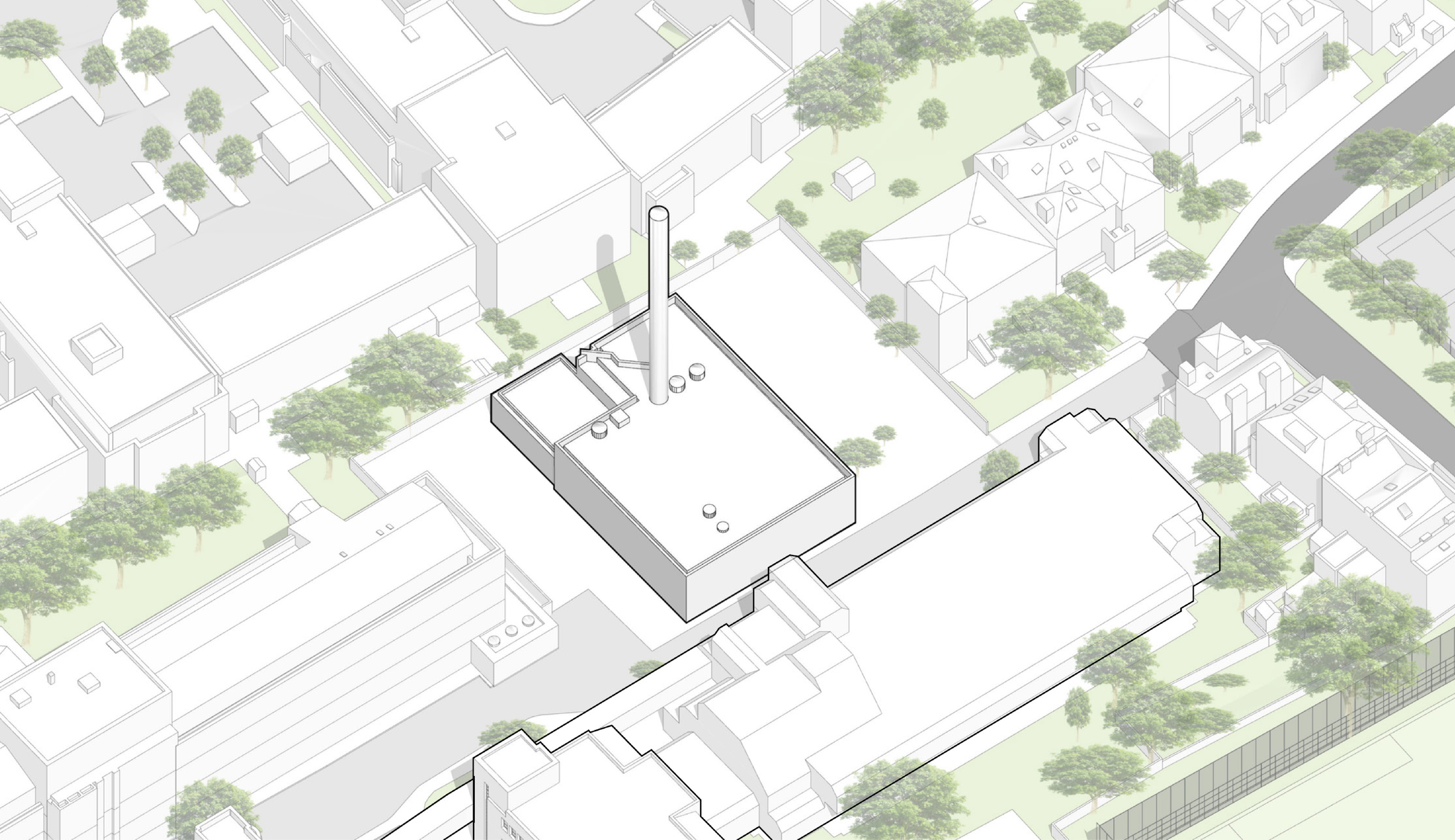
The Boiler House is located on Ravenscourt Square, which is a private road owned by the applicant, TT Group. It was historically part of the Ravenscourt Park Hospital campus and measures just over 0.2 hectares. The site sits between the former hospital buildings to the east, the Chiswick Nursing Centre to the south, residential properties on Invermead Close to the west, and homes on Ravenscourt Square to the north.
-
TT Group own the site.
-
The Boiler House has been vacant for several years. It once contained the mechanical infrastructure that supported the hospital estate but is now derelict and unused.
-
No. The Boiler House will come forward as a separate planning application. The proposals were approved by Hammersmith and Fulham’s Planning and Development Control Committee in July 2025. The Boiler House was acquired later, which allows it to be brought forward now as a complementary scheme.
Planning Context
-
A full planning application will be made to the London Borough of Hammersmith and Fulham. It will seek permission to demolish the existing structure and replace it with a new residential building of six storeys, delivering forty-seven new homes.
-
The Boiler House is not listed. However, it is located within the Ravenscourt and Starch Green Conservation Area and is surrounded by significant heritage assets. These include the Grade II* listed former Royal Masonic Hospital immediately to the east, several Grade II listed houses on Ravenscourt Gardens to the south, and one Grade II listed property on Ravenscourt Square to the north. The new design has therefore been developed with care to respect and enhance this historic context.
-
The Boiler House was acquired following the submission of the planning application for the development Ravenscourt Park Hospital (RPH). As a result, it was not considered appropriate to include it in the original plans at that stage. The design of the main hospital took into account the future redevelopment of the Boiler House. Its subsequent acquisition now provides an opportunity to bring forward a complementary proposal that aligns with the overall vision for the site.
-
There will be a mix of one, two and three bedroom flats. This variety ensures that the development can meet the needs of individuals, couples and families.
-
Homes will vary in size from fifty square metres to ninety-eight square metres, depending on the number of bedrooms and layout. All of them will either meet or exceed London Plan space standards.
-
Yes. Ten per cent of the homes will be wheelchair accessible, in line with policy requirements.
-
The new building will have a ground floor and five further storeys above. This height is consistent with neighbouring developments. The upper floors step back to reduce the visual impact on surrounding homes. The basement of the existing building will be retained and used for plant and cycle storage.
-
The building has been designed to step back at upper levels to respect surrounding homes. A detailed daylight and sunlight assessment has informed the design so that overshadowing is minimised. Separation distances to neighbouring buildings will be maintained or, in some cases, increased compared with the current situation.
-
Yes. Every home will have its own private balcony or terrace that meets the London Plan size standards. In addition, landscaped gardens and courtyards will be provided for communal use by residents.
Homes and Design
Transport and Access
-
Vehicles will enter from the south of Ravenscourt Square and leave northwards onto Goldhawk Road. Barriers at either end of Ravenscourt Square will be reinstated to manage traffic. Access will be controlled by a concierge system, with residents using fobs or codes.
-
The development will be car free, in line with the London Plan. Two blue badge spaces will be provided for disabled residents or visitors.
-
Eighty-four long-stay cycle spaces will be provided in secure stores at basement and ground floor level, with three short-stay visitor spaces available outside.
-
An initial Transport Assessment has been carried out. The scheme is expected to generate only a small number of vehicle trips each day, mostly from deliveries and servicing. These movements are consistent with those assessed for the wider hospital development and will have no material impact on local congestion or the use of Ravenscourt Square.
-
Deliveries and refuse collection will take place from a dedicated loading bay on Ravenscourt Square. This bay can accommodate a refuse lorry or smaller vans without affecting neighbouring roads. An on-site caretaker will manage waste by moving bins between the stores and the loading bay.
-
The site is well served by public transport. Bus services operate from Goldhawk Road and King Street, and there are Underground stations at Stamford Brook, which is four hundred metres away, and Ravenscourt Park, which is six hundred and fifty metres away. Most resident journeys are expected to be made by public transport, walking or cycling.
The majority trips are expected to comprise of trips made via the London Underground and train travel modes; consisting of 47 daily arrival movements and 53 daily departure movements.
The proposals would therefore have a negligible impact upon the he local London Underground network capacity, the local pedestrian network and that the slight uplift in bus trips generated by the development proposals would be comfortably accommodated within the existing bus network.
-
Sustainability is central to the design. Measures include high performance insulation, heating and hot water provided by air source heat pumps, sustainable drainage systems, green roofs, biodiversity planting, and the use of recycled and durable materials. The building has also been designed to maximise natural daylight and reduce energy demand.
-
Yes. The proposed development will apply circular economy principles to minimise waste and maximise material value, prioritising the reuse and recycling of resources throughout the building’s life cycle.
Sustainability
-
All high quality (Category A) and medium quality (Category B) trees will be retained wherever possible. Where removals are unavoidable, they will be replaced with at least the same number of higher quality, semi mature trees.
-
Sustainable urban drainage systems (SuDS) will be integrated to improve water quality and slow water runoff. The risk of flooding from sewers, groundwater, or artificial waterbodies is low.
Environment
-
Workshops will be held with immediate neighbours on Ravenscourt Square and Invermead Close. Wider consultation will take place through a dedicated project website and an online feedback form. Local groups such as the Hammersmith Society and ward councillors will also be engaged.
-
Redeveloping this long-vacant site will reduce opportunities for antisocial behaviour. The new residential scheme, with active frontages and regular activity, will create a safer and more welcoming environment for the local community.
-
The proposals will deliver a range of community benefits including:
The delivery of high-quality housing, including some affordable housing, consistent with the main hospital development
Restoration of the building line and public realm along Ravenscourt Square
Enhanced landscaping and pedestrian connections
Improved safety by activating a previously derelict site
Job creation during construction
Increased local spending from new residents
An uplift in Council Tax receipts and securing New Homes Bonus Monies
Appropriate financial contributions through LBHF’s and the GLA’s Community Infrastructure Levy (CIL) and via Section 106 legal obligations – subject to viability and statutory tests